Business

Business
First ever field pilot on Alaska's north slope to validate the use of polymer floods for heavy oil EOR.
Project Description
The field pilot test will be implemented in the Milne Point Field (MPF) which includes 35,744 acres and is located approximately 30 miles northwest of Prudhoe Bay on the Alaska's North Slope (ANS). The Milne Point Field consists of four oil pools, starting from the top: Ugnu, Schrader Bluff, Kuparuk River and Sag River, while the project reservoir is in the Schrader Bluff formation. The Schrader Bluff formation extends between 3400 ft to 5200 ft true vertical depth subsea (TVDss). This late cretaceous age formation is divided into two stratigraphic intervals, namely O sands and N sands. O sands are subdivided into OB and OA, while N sands have subintervals NF, NE, ND, NC, NB, NA. The structure of the pool is homocline with 1-2° dip from East to Northeast. Schrader Bluff O sands were deposited 70 million years ago from marine shoreface and shelf deposits. They consist of fine-grained, quartz-rich sandstone interbedded with siltstone and mudstone. The overlying N sands were deposited within wave-dominated shoreface and deltaic systems. Upward coarsening is evident with mudstone and siltstone dominating the lower portion of this interval. There is no evidence of free gas accumulation within the Schrader Bluff formation, but complex fault blocks have compartmentalized this pool (Bidinger and Dillon 1995). The project reservoir is in the Schrader Bluff NB-sand, an unconsolidated sandstone. The project reservoir has generally excellent petrophysical properties, with porosity ranging from 31%-35% and permeability ranging from 100 to 3,000 mD. The average thickness of the reservoir is about 15 ft and the reservoir temperature is about 70°F. API gravity of oil is about 15 with in-situ oil viscosity of 330 cP in the project area. Preliminary laboratory and simulation studies indicated that polymer flooding has great potential to enhance oil recovery from the Schrader Bluff heavy oil reservoirs (Seright 2010, 2011), yet no field test has been performed to date in Alaska. In fact, no large-scale polymer flood of a heavy oil and other unconventional resources has occurred to date in the entire United States, although it has been tested and implemented in other countries, such as Canada and China. Initial scoping studies suggest that successful implementation of polymer flooding could increase heavy oil recovery by 50% on the North Slope of Alaska and increase America's oil reserves by tens of billions of barrels.
University of Alaska – Fairbanks
Project Benefits
The overall goal of the project is to acquire scientific knowledge and field data by assessing an advanced polymer flooding technology in the Schrader Bluff heavy oil reservoir on ANS. The advanced technology will effectively integrate the advantages of polymer injection, low salinity water, horizontal wells, and conformance improvement together to significantly enhance oil recovery for heavy oil reservoirs. The project will also aid the industry’s general understanding of polymer flooding by resolving the optimum polymer viscosity and salinity to inject during heavy-oil recovery. Once successful, the developed technology will provide a cost-effective and environmentally friendly technology for heavy oil development on ANS. Specifically, the detailed objectives that would enable the achievements of the project include:
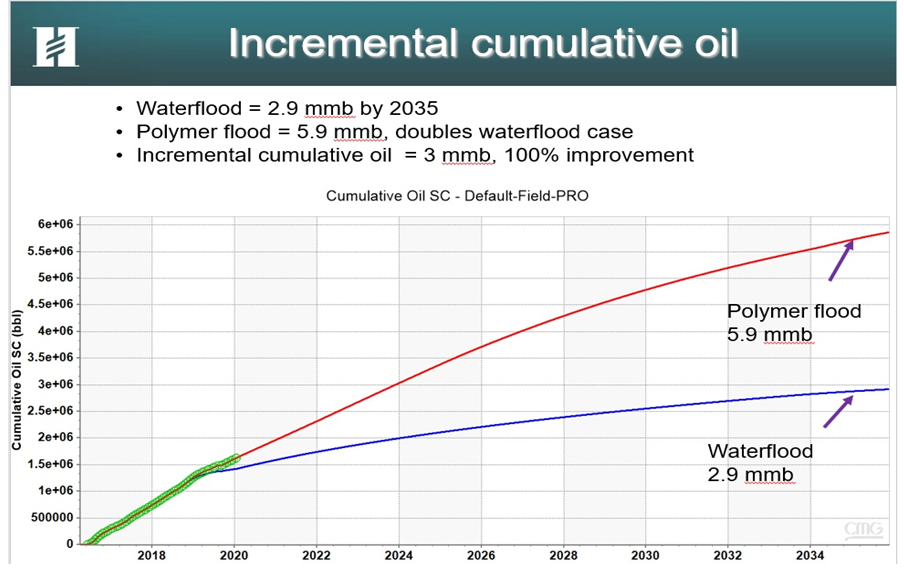
These objectives are consistent with the aspects of the DOE solicitation -DE-FOA-0001722. First, it targets Topic 1: Technology Validation using Field Laboratories on Alaska North Slope, the Schrader Bluff Formation - an unconventional heavy oil formation. Our proposed project will validate an advanced polymer EOR technology to increase oil production from the field pilot test wells. Second, the objective is targeted on the Subtopic 1A: Established Unconventional Oil and Gas Plays. The proposed field test is focused on heavy oil, an unconventional resource on the Alaska North Slope, and especially the objective to stress the improvement in flow conformance and sweep efficiency using an advanced polymer EOR process which will integrate polymer, low salinity water, conformance control, horizontal wells into one process to significantly improve oil recovery in an unconventional heavy oil reservoir in the USA, especially on ANS.
PROGRESS IN 2019
$7,131,065
$2,584,285
Federal Project Manager David P. Cercone: david.cercone@netl.doe.gov
Technology Manager Jared Ciferno: jared.ciferno@netl.doe.gov
Principal Investigator Abhijit Dandekar, PhD.: adandekar@alaska.edu
Refereed Journals
Conference Proceedings
Media and Outreach
Presentations, Papers, and Publications