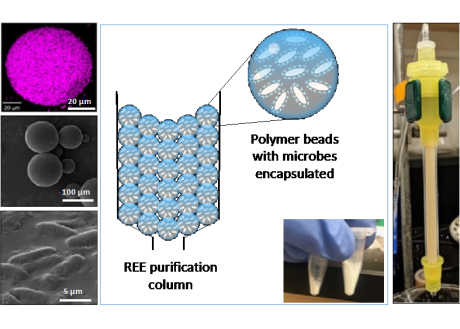
U.S. Department of Defense (DOD) progress on a $4 million plan to pursue a technology for recovering rare earth elements (REEs) and other critical minerals from coal ash, has its roots in a ground-breaking project spearheaded by NETL and private partner – Physical Sciences Inc. (PSI).
The DOD’s action is an example of how NETL leverages cooperative partnerships for technology development in the public and private sectors.
The U.S. Department of Energy (DOE) today released a Request for Information (RFI) on the design, construction and operation of a new facility to demonstrate the commercial feasibility of a full-scale rare earth element (REE) and critical minerals (CM) extraction and separation refinery using unconventional resources. When built, this first-of-a-kind facility, supported by $140 million investment from the Bipartisan Infrastructure Law, will support American manufacturing jobs, and help build a strong domestic supply chain for the next generation of clean energy technologies vital to reaching President Biden’s goal of a net-zero emissions future.
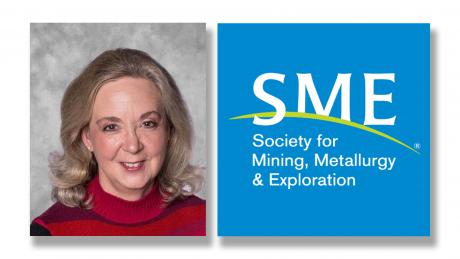
NETL will soon have the opportunity to share its research initiatives in the field of rare earth elements (REEs) and critical minerals (CMs) with the greater mining and engineering communities when Mary Anne Alvin presents before the Society for Mining, Metallurgy & Exploration (SME). Her acceptance of the nomination to be a 2021-2022 SME Henry Krumb Lecturer will enable her to present research and findings of the U.S. Department of Energy Office of Fossil Energy and Carbon Management (FECM) with SME’s members.
NETL leadership and experts, including NETL Director Brian Anderson, Ph.D., joined representatives from 11 universities as they gathered virtually to discuss project successes during the 2021 University Coalition for Fossil Energy Research (UCFER) Annual Technical Review Meeting this week.
NETL Deputy Director and Chief Technology Officer Sean Plasynski, Ph.D., kicked off the second day of the meeting with opening remarks, proceeded by an administrative update from UCFER DOE Project Officer Omer Bakshi.
NETL Director Brian Anderson, Ph.D., will welcome representatives from 11 universities for the virtual 2021 University Coalition for Fossil Energy Research (UCFER) Annual Technical Review Meeting Oct. 5-6, 2021.
“Partnerships like UCFER help the Lab leverage its connections, resources and expertise to develop critical carbon management technologies,” Anderson said. “The dedication of our University partners across UCFER to our mission is an inspiration when we see the innovations from see the best and brightest minds from universities across the country.”
NETL’s Research & Innovation Center’s (RIC) work to develop domestic supply chains of critical minerals (CMs) and rare earth elements (REEs) from unconventional sources such as carbon ore ash, acid mine drainage and other sources has resulted in several milestones in technological applications of sensors and geoscience.
NETL’s Mary Anne Alvin sees a brighter future ahead for the nation’s energy communities that have powered the nation for more than a century as the U.S. undergoes a historic transformation to clean energy.
The U.S. Department of Energy's (DOE) Office of Fossil Energy and Carbon Management (FECM) announced the selection of six projects to receive a total of nearly $1 million in federal funding for cost-shared research and development (R&D) under funding opportunity announcement (FOA) 2404, Advanced Processing of Rare Earth Elements and Critical Minerals for Industrial and Manufacturing Applications.
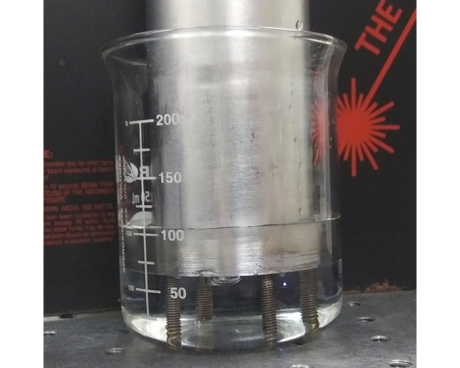
The National Energy Technology Laboratory (NETL) is partnering with Lawrence Livermore National Laboratory (LLNL), Duke University and the University of Arizona to develop a reactor that will selectively concentrate rare earth elements (REEs) in an environmentally benign way.
In partnership with NETL, researchers at Idaho National Laboratory (INL), Rutgers, Arizona State University, OLI Systems and Lawrence Livermore National Laboratory are developing new sensing methods of detecting rare earth elements (REEs) contained within America’s fossil energy resources using luminescent detection.