Back to Top
Skip to main content
NETL Logo
School Visit
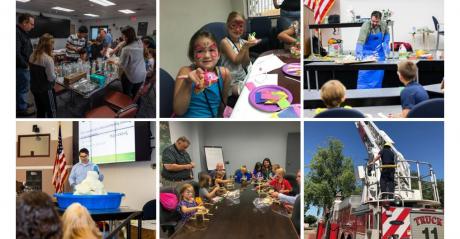
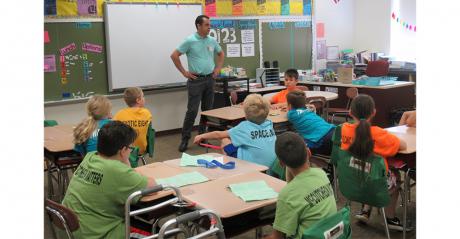
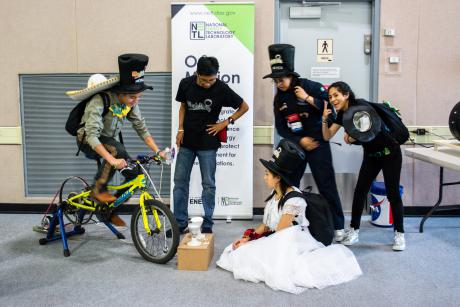
Paul Ohodnicki, Ph.D., of NETL’s Functional Materials team, visited Central Elementary School in Allison Park, Pennsylvania, May 31 to share his expertise in science, technology, engineering and math (STEM) by assisting with Hampton Township School District’s Science Olympiad. With support from the Lab’s STEM K-12 Education & Outreach team, Ohodnicki encouraged students to solve real-world engineering problems through application of the engineering design process during the event.
2019 Mickey Leland and CIESESE Students
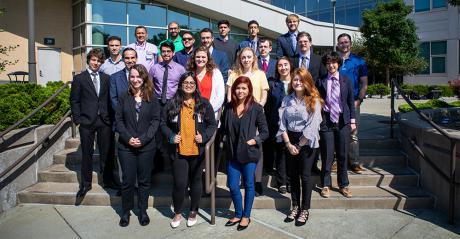
NETL welcomed more than 40 research associates June 3 as the Lab opened its doors to participants in the Mickey Leland Energy Fellowship (MLEF) and Consortium for Integrating Energy Systems in Engineering and Science Education (CIESESE) programs. The summer research associates include science, technology, engineering, and mathematics (STEM) majors who will get hands-on experience in NETL’s world-class facilities and conduct research one-on-one with the Lab’s expert scientists and engineers. Sponsored by the U.S. Department of Energy’s (DOE) Office of Fossil Energy, MLEF kicks off its 24th year with a class of 34 undergraduate and graduate students. The program was named after late Congressman Mickey Leland of Texas, a passionate advocate on many issues who died in a 1989 plane crash while on a mission to Ethiopia. 
Lazer
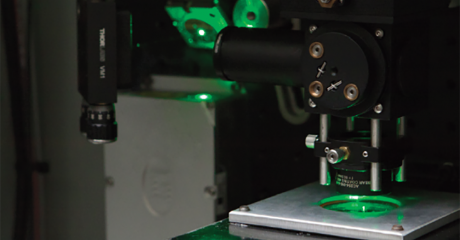
A leading-edge sensing technology developed by NETL researchers designed to enable more flexible operation of gas-fired power plants is advancing toward commercialization as part of a partnership with turbine manufacturer Solar Turbines Incorporated. NETL’s Raman Gas Analyzer provides the capability for real-time control of turbine machinery based on fuel composition. A cooperative research and development agreement (CRADA) with Solar Turbines provided testing to help advance this technology toward commercialization. Its eventual implementation will enable more flexible operation of gas-fired power plants, creating clean, affordable power from domestic fuel sources.
TUBE
NETL is battling the destructive effects of corrosion and other risks to the natural gas pipeline infrastructure by developing fiber-optic sensor systems that can monitor vital natural gas pipelines from within. The data will provide critical information for early detection and help avoid expensive pipeline failures to maintain affordable, reliable energy for consumers. Natural gas pipelines are arteries that fuel many of the nation’s fossil-energy power plants. However, like all metals, every inch of pipe is susceptible to corrosion. According to worldwide corrosion authority NACE International, corrosion adds billions of dollars to operation and maintenance expenses each year. Amongst other benefits, mitigating these preventable costs could result in lower energy bills for consumers.
Single Crystal Optical Fiber
Turbines, nuclear power plants and chemical reactors operate at increasingly higher temperatures to boost efficiency and reduce expenses. However, these extreme temperatures also create harsh environments that contribute to corrosion, oxidation and other materials challenges in monitoring advanced energy systems. NETL’s novel laser-heated pedestal growth system enables researchers to fabricate custom single-crystal optical fibers from bulk materials, such as sapphire or yttrium aluminum garnet (YAG), that can withstand ultra-high temperatures. Now, researchers are building upon that work to incorporate these specially made fibers into fully distributed sensing systems that effectively monitor temperatures, strains or other important parameters up to 1,500 degrees Celsius, or more than 2,700 degrees Fahrenheit.
FOA Logo
The U.S. Department of Energy’s (DOE) Office of Fossil Energy and NETL have announced up to $5 million in federal funding for cost-shared research and development (R&D) projects under the funding opportunity announcement (FOA) DE-FOA-0002004, Low Cost, Efficient Treatment Technologies for Produced Water. These projects will accelerate the development and commercialization of treatment technologies that reduce waste water and increase fresh water supplies. The selected projects will support the Produced Water R&D program, which develops technology to reduce the amount of waste water from oil and natural gas production operations. The National Energy Technology Laboratory (NETL) will manage the selected projects, which will focus on developing new technologies and on improving the efficiency of existing commercial processes — specifically, those that target removal of challenging constituents.
Science One
Enter the NETL Energy Zone: Build your own working circuits, experiment with energy transfer, energize an electromagnet to send a metal ring high in the air and battle friends for the title of Energy Champion. Photo courtesy of Carnegie Science Center.Sound like fun? At Pittsburgh’s Carnegie Science Center, children can explore these exciting exhibits and more as they expand their energy knowledge. NETL’s collaboration with the family-friendly facility is part of the Lab’s commitment to educating the next generation of researchers, scientists and engineers who will one day work to develop technological solutions to the nation’s energy challenges. Carnegie Science Center is one of four Carnegie Museums of Pittsburgh. Located on the Steel City’s North Shore, its mission is to delight, educate and inspire through interactive experiences in science and technology.
Gas Stream Cleanup
The National Energy Technology Laboratory (NETL) and Oak Ridge National Laboratory (ORNL) are teaming up to optimize coal gasifier operation through neutron imaging — an effort that could lead to more efficient energy production than that of conventional methods. The collaboration brings together NETL’s expertise in fossil energy and computational modeling with ORNL’s capabilities in neutron imaging. The research team will use neutron imagining techniques to observe coal gasifier behavior during operation and then validate results from computer-simulated models used for design and optimization. Gasification is the process that converts bio- or fossil-based feedstocks into syngas, which can be used for highly efficient energy and chemical feedstock production. Syngas, composed primarily of carbon monoxide and hydrogen, can be used in a variety of ways. It can aid in the production of fuel and chemical feedstocks, and CO2 removed from syngas prior to combustion helps enable carbon capture and sequestration. This makes gasification a critical technology in the search for clean energy supplies and domestic energy security.
Earthday
At NETL, maintaining responsible stewardship of the environment is crucial to the Lab’s mission of finding innovative solutions to America’s energy problems. Earth Day, celebrated since 1970, aligns closely with NETL’s vision while emphasizing the importance of recycling, conserving energy and improving air quality. Every year, NETL hosts an annual poster contest encouraging elementary school students at schools near NETL’s sites in Albany, Oregon; Morgantown, West Virginia; and Pittsburgh, Pennsylvania, to showcase their favorite ways to protect the environment. This year, students were asked to design their posters around the theme, “Protect our Earth’s Plants, Care for its Creatures,” in recognition of this planet-centric day. We have shared the first-, second- and third-place winning entries, as well as honorable mentions, at each grade level here. The top entries are also displayed at U.S. Department of Energy headquarters in Washington, D.C., and all NETL sites through May 10, 2019.
WVU’s bench-scale fluidized bed gasifier is providing valuable experimental data that is helping validate computer models at NETL.
NETL’s world-renowned computer modeling capabilities are front and center in a pivotal collaboration with West Virginia University (WVU). Computational modeling is a critical tool in technology development, and the forward-looking efforts by the NETL-WVU research team are improving the accuracy of fossil-fuel energy systems models — work that will ultimately help provide the nation with cost-effective, sustainable and efficient clean energy. The NETL-led team is investigating gasification, a promising technology that can convert fossil fuels like coal into a highly useful mixture of hydrogen and carbon monoxide called synthesis gas or syngas. Because it can be used directly as fuel and as a precursor to an array of chemicals and products, syngas could become a major game changer in the fossil fuel industry. The NETL-WVU team is seeking to understand how to optimize gasification and syngas production.