
 Share
 Contact
The U.S. Department of Energy/National Energy Technology Laboratory’s (DOE/NETL) Power, Fuels, and Chemicals Program, operating under the Office of Oil and Gas, plays a crucial role in advancing the conversion and utilization of domestic hydrocarbons into reliable electric power, transportation fuels, and commodity chemicals, while supporting sustainable domestic energy production. The program's strategic focus is to develop advanced energy systems that deliver low-cost baseload power and high-value products. To achieve this, the Program integrates key technology areas—including Advanced Turbines, Solid Oxide Fuel Cell Embedded Gas Turbines (SOFC-GT), and Advanced Energy Materials—to accelerate the commercial deployment of high-efficiency, flexible energy systems. Within this framework, the Solid Oxide Fuel Cell (SOFC) initiative advances technologies for efficient, cost-effective electricity generation using domestic natural gas and coal-derived syngas. A particularly promising application is the deployment of natural gas-fueled, oxygen-conducting SOFC-GT systems to provide dedicated, distributed power for Super Intelligence (SI) data centers.

Worldwide demand for high-efficiency, highly reliable distributed power is creating significant global market opportunities for SOFC-GT systems. Commercial interest and pilot exploration are accelerating across key sectors—most notably in Super Intelligence (SI) data centers, distributed generation, telecommunications backup, maritime power, and combined heat-and-power (CHP) systems. To advance these systems from development and pilot demonstrations to full commercial readiness, the program focuses on targeted research incorporating Super Intelligence and Machine Learning (SI/ML) to develop robust control strategies that manage the complex integration of SOFCs embedded in gas turbines, ensuring system stability, operational efficiency, and component protection. By directly addressing the unique operational and control challenges of hybrid SOFC-GT systems, the program aims to build industry confidence and accelerate commercial deployment.
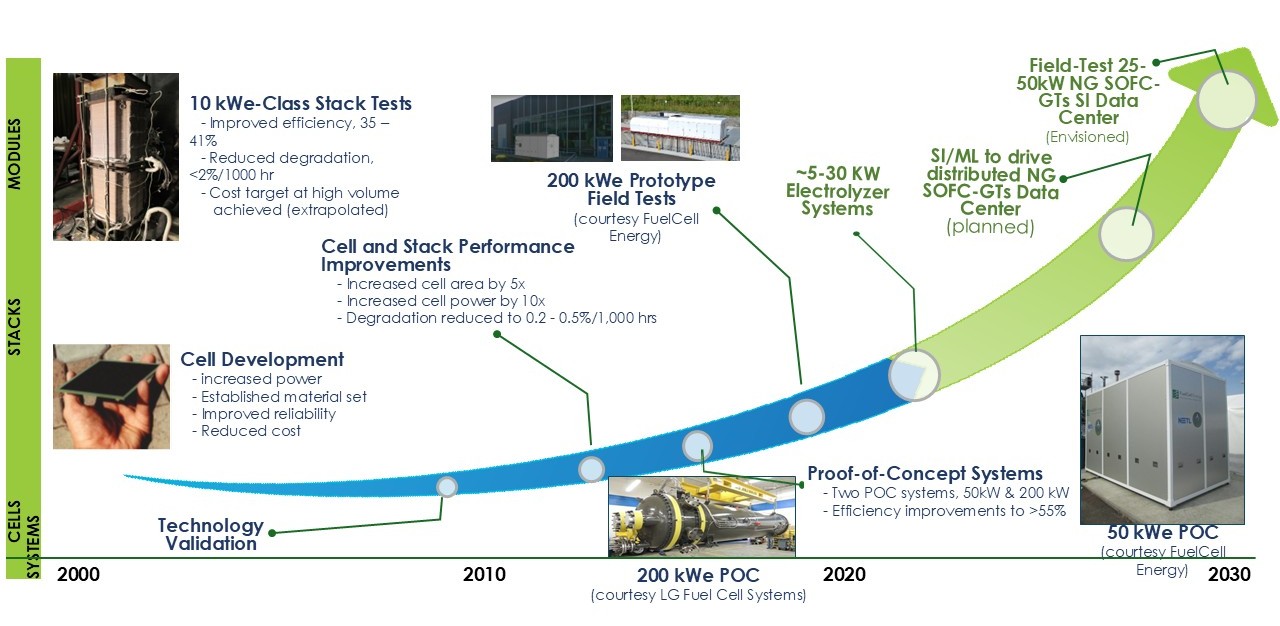
DOE, through NETL, initiated the Solid-State Energy Conversion Alliance (SECA) in 1999 to develop low-cost, environmentally friendly SOFC technology to produce electricity with an emphasis on distributed generation applications. Since its inception in 1999, the SOFC program under SECA has driven significant progress toward commercializing oxygen-conducting SOFC systems for power generation. Figure 2 illustrates the two-decade evolution of this technology, highlighted by the successful field testing of a 200-kilowatt (kW) integrated standalone SOFC system circa 2020. Building on these achievements, the program is now advancing toward a planned 25–50 kW natural gas-fueled SOFC Embedded Gas Turbine (NG-SOFC-GT) field demonstration tailored for high-reliability Super Intelligence (SI) data center applications. Today, the NETL SOFC Program maintains a portfolio of R&D projects intended to prepare the SOFC for market applications, including high-power, low-cost electricity generation.
SOFC Embedded Gas Turbines (SOFC-GTs)
Oxygen-conducting SOFC technology, particularly when embedded with gas turbines (SOFC-GTs), presents an efficient solution for on-site power generation, characterized by high electrical efficiency, typically 50% to 60% LHV for SOFCs, and significant fuel flexibility, accommodating natural gas, biogas, and coal syngas. Their reliability enables high-power 60% to 80% LHV SOFC-GTs to help address grid constraints, reduce emissions, and ensure consistent uptime for critical operations. When incorporated into a sophisticated microgrid, they can also provide essential baseload power, complementing renewable energy sources and enhancing energy independence and reliability, especially for facilities like SI data centers.
The Power, Fuels, and Chemicals program is actively developing technologies to accelerate the market deployment of advanced, higher power, and highly flexible gas turbines to meet the anticipated increase in power generation demand from data centers, other high-tech industries, and manufacturing sectors, with key research and development areas such as natural gas turbines with embedded SOFCs and pressure gain combustion expected to significantly increase efficiency. When SOFCs are combined with turbines, this configuration creates highly power-dense natural gas electric power generators, which recover waste heat from the fuel cell to drive the turbine, thereby significantly boosting overall system efficiency, often exceeding 70% to 80%, and enabling scalable, distributed generation directly at the point of use.
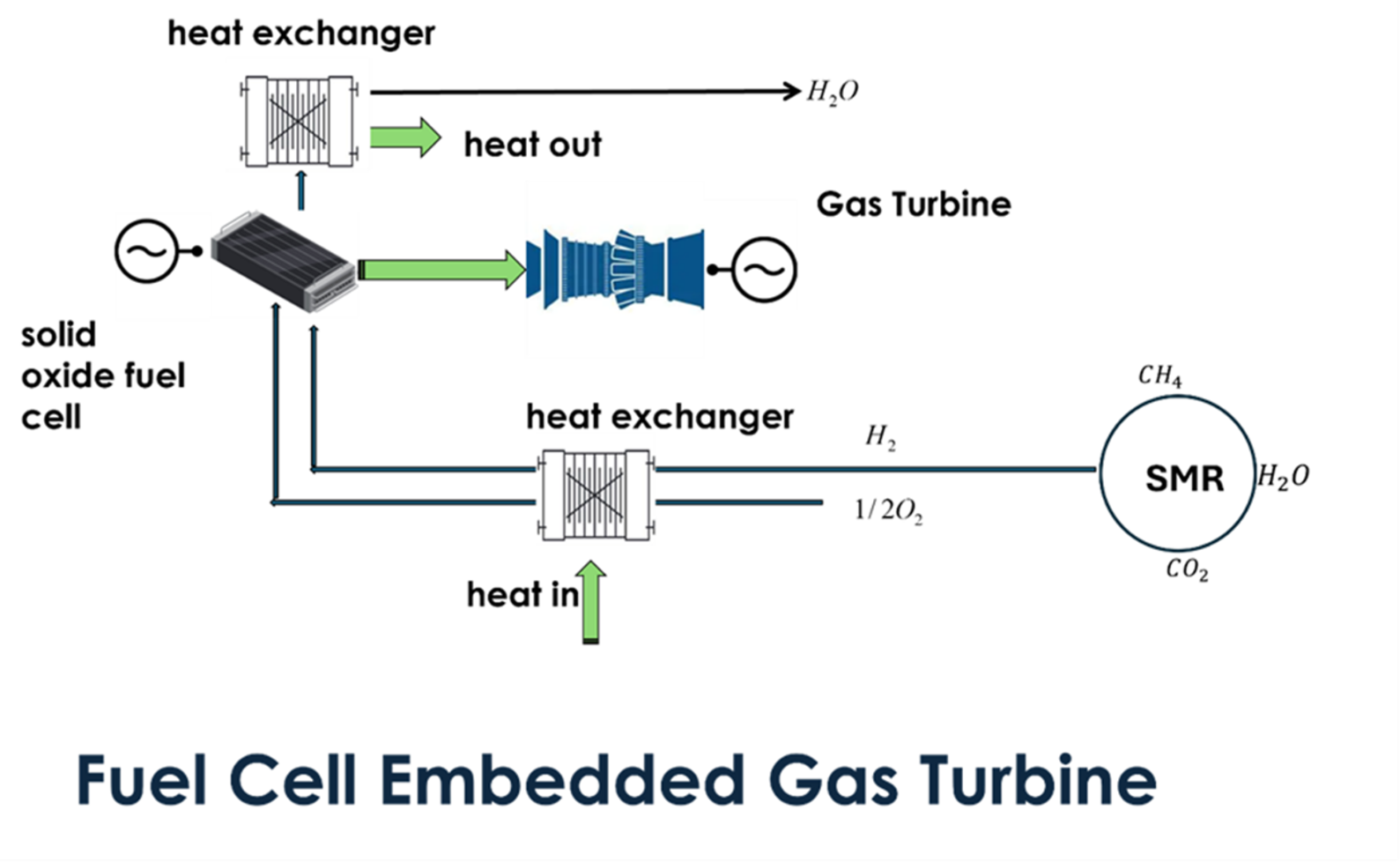
One promising approach involves integrating high-current, low-resistance, oxygen-conducting SOFC-GTs. This hybrid system aims to create a power device that surpasses the output of either an SOFC or a GT operating independently. The effectiveness of an SOFC-GT hybrid system heavily relies on how these two components are integrated. These systems are designed to maximize power by utilizing the high-temperature exhaust from one component to power the other. The combination introduces trade-offs that can be managed to get the best possible performance. The program will focus on managing the differing responses of SOFCs and gas turbines, researching long-term degradation and alternative materials to improve SOFC stability and lifespan, and reducing high system costs for commercialization. These include:
- Operating temperatures and pressures: Balancing the optimal operating conditions for both the oxygen-conducting SOFC and the GT
- GT speed: Adjusting the gas turbine's rotational speed
- SOFC fuel utilization: Optimizing how much of the fuel the SOFC converts into electricity
- SOFC operating current: Managing the electrical current generated by the SOFC.
- SOFC thermal management
- SOFC total resistance: Minimizing resistance within the SOFC to improve performance and increase current
- Relative SOFC and GT size: Determining the appropriate sizing of each component for optimal synergy
- Flowrate of cathode excess air for SOFC cooling: Ensuring adequate cooling for the SOFC
Developing, ensuring stable operation, and preventing damage under varying conditions are crucial aspects in the advancement of SOFC-GT hybrid systems. SOFC-GT hybrid systems hold significant potential for high power output, reduced emissions, and fuel flexibility, making them an attractive option for power generation.
Explore the Site






NETL implements this effort as part of DOE’s Power, Fuels, and Chemicals Program.