
 Share
Share Contact
Modernizing the Geothermal Workforce
The Regional Workforce Initiative (RWFI) leverages national expertise in drilling and reservoir engineering to create a talent pipeline that will position geothermal as a solution to meet rising U.S. energy demand.
Strategic Priorities
The Geothermal Energy Systems Workforce Hub is advancing workforce capacity across geothermal resource exploration, drilling, reservoir engineering, power generation, and direct-use applications to support U.S. energy reliability and baseload power deployment.
Comprehensive Workforce Analytics
Workforce Readiness
Strategic Workforce Integration
Industry and Education Alignment
Digital Infrastructure
Systemic Workforce Challenges
Subsurface Talent Bottleneck
Limited geophysics programs and long training timelines create a massive scaling constraint.
Primary scaling constraint
Experience-Based Roles
Degrees alone are insufficient; drill operators and field engineers require hands-on site knowledge.
Beyond credentials
Competition for Trades
High demand for welders and mechanics from data centers and manufacturing creates hiring pressure.
Wage and stability competition
Geographic Mismatch
Resources are concentrated in the Western United States while workforce pools are often located elsewhere.
Relocation barriers
Workforce Awareness
Less visibility than wind or solar energy results in underutilization of transferable talent pools.
Visibility gap
Fragmented Talent Pipeline
Lack of unified systems are available connecting DOE tech development to industry demand and training.
Deployment timeline mismatch
Workforce Needs and Gaps Explorer
This tool addresses the systemic challenge of mapping skill adjacencies for research-, pilot-, and commercial-scale staffing needs by connecting occupational demand to Standard Occupational Classification (SOC) categories.
Workforce Intelligence Visuals
These data-driven visuals provide insights into supply chain segments and talent mobility.
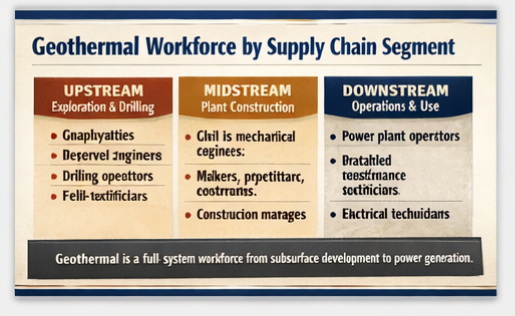
Supply Chain Segments
Subsurface to Power Generation
Upstream
Geoscientists · Reservoir Engineers · Drilling Operators
Focus: Resource characterization and wellbore construction
Midstream
Mechanical Engineers · Specialized Welders · Construction Managers
Focus: Plant construction and system integration
Downstream
Plant Operators · Maintenance Techs · Electrical Technicians
Focus: Continuous operations and grid reliability
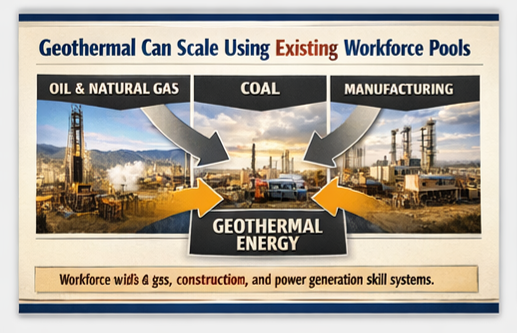
Workforce Scalability
OIL & GAS
COAL
MANUFACTURING
GEOTHERMAL ENERGY
Workforce scalability leverages mature skill systems from extraction and power generation systems.
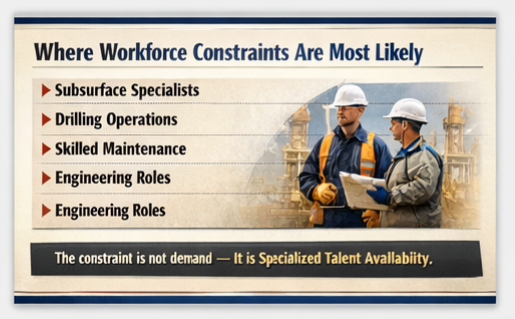
Talent Scarcity Index
- Subsurface Specialists
- Drilling Operations
- Skilled Maintenance
- Engineering Roles
Constraint is not demand; it is specialized talent availability.
Geothermal Basics
Electricity Generation
The Earth's inner core is incredibly hot, about 10,800 degrees Fahrenheit. Using natural or human-made permeability and fractures, fluids flow through the hot rocks, absorbing heat from the rocks that can be drawn up through wells to the surface. That heat energy is then converted to steam, which drives turbines that produce electricity.
Heating and Cooling
Geothermal resources such as naturally occurring underground reservoirs of hot water or the stable temperature of the subsurface can be used to heat and cool buildings. Geothermal heat pumps provide heating and cooling using the ground as a heat sink, absorbing excess heat when the aboveground temperatures are warmer, and as a heat source when aboveground temperatures are cooler. District systems with a series of pumps are used to heat and cool entire communities.
Geothermal Energy 101
See how we can generate energy from heat sources deep beneath Earth's surface. This video highlights basic principles and three ways heat is converted into electricity.
Strategic Priorities
The RWFI is advancing workforce capacity across extraction, processing, refining, materials engineering, and advanced manufacturing to support U.S. mineral independence.
1. Comprehensive Workforce Analytics
Developing a quantitative Workforce Needs and Gaps Analysis will evaluate workforce transferability from oil and gas, mining, construction, and power generation into geothermal exploration, drilling operations, reservoir management, and plant operations.
2. Workforce Readiness
Implementing regionally focused Workforce Readiness Scans will begin in high-potential geothermal regions (Western United States and Gulf Coast for geothermal co-production and emerging Enhanced Geothermal Systems (EGS) zones), and will expand nationally, examining skill adjacency, drilling capacity, and workforce scaling potential under multiple technology deployment scenarios.
3. Strategic Workforce Integration
Aligning workforce analysis with federal geothermal deployment strategies, permitting pathways, and grid reliability will support workforce planning in energy deployment.
4. Industry and Education Alignment
Catalyzing coordination among geothermal developers, oilfield service companies, utilities, drilling contractors, universities, and community colleges will align training pathways with evolving geothermal technologies, including EGS zones and co-produced resources.
5. Digital Infrastructure
The Geothermal Energy Systems Workforce Hub and online Paybook will provide interactive dashboards, regional readiness indicators, occupation pathways, and workforce transition tools tailored to geothermal and cross-sector workers entering the industry.