

 Share
Share Contact
Modernizing the Coal Energy Workforce
The Coal Energy Systems Workforce Hub is dedicated to strengthening U.S. energy security and industrial competitiveness by advancing a highly skilled coal workforce. We align workforce readiness with next-generation coal technologies, including high-efficiency power generation and coal-based advanced manufacturing, to support reliable baseload energy, domestic supply chains, and strategic industrial resilience.
RWFI Strategic Priorities
RWFI functions not as a training provider, but as a workforce integration platform — delivering analytics, coordination, and tools that enable federal, industry, and educational partners to support the creation of energy jobs.
1. Needs and Gaps Analysis
Linking Standard Occupational Classification (SOC) and the North American Industry Classification System (NAICS) to scale-up phases
2. Readiness Scans
Skill adjacency and labor availability
3. Online Playbook
Transition pathways for energy workers
Systemic Workforce Challenges
Experience-Dependent
Safety-critical extraction roles require years of hands-on, site-specific knowledge that cannot be quickly replaced.
Develop-over-time system
Aging and Replacement
Workforce gaps are driven primarily by high retirement exposure and the loss of critical institutional knowledge.
Replacement > Growth demand
Limited Entry Pipeline
The system is top-heavy, with a heavy concentration in mid-high skill roles and insufficient feeder pathways.
Weak entry-level entry
High Skill Intensity
Approximately 83% of roles require advanced mechanical knowledge, process control, and safety compliance mastery.
Applied competency focus
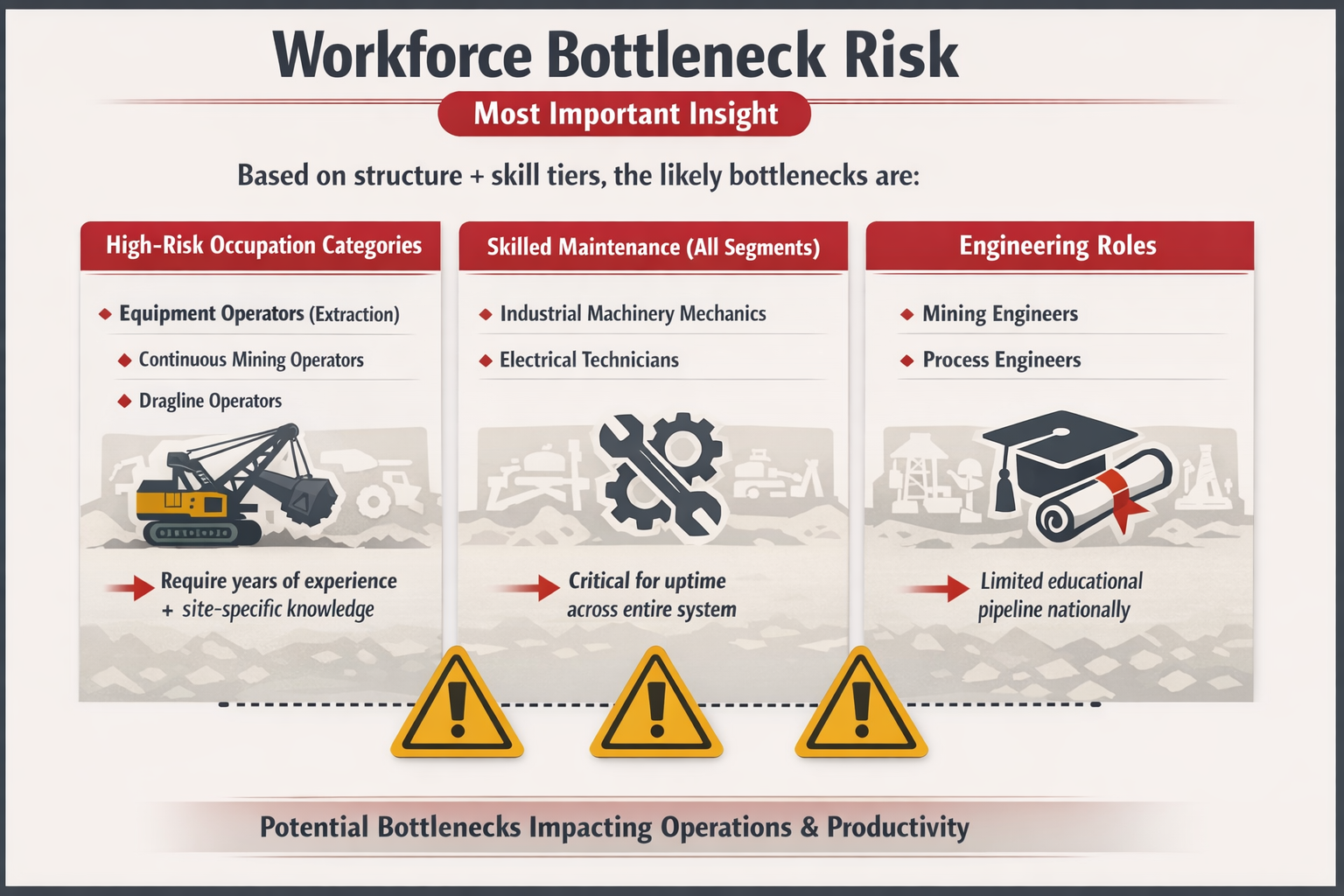
Maintenance Bottleneck
Maintenance roles span all segments and serve as the single point of failure for supply chain uptime.
Crosscutting systemic risk
Engineering Constraints
Declining enrollment in mining programs creates a high-impact bottleneck for innovation and optimization.
Low-volume, high-impact
Geographic Constraints
Workforce is regionally constrained (Appalachia/West), making local shortages difficult to solve externally.
Regionally constrained
Industry Dependence
Coal relies on cross-industry ecosystems, primarily construction and manufacturing, for talent inflows.
Cyclical supply risks
Safety Complexity
Regulatory and Mine Safety and Health Administration (MSHA) compliance create structural barriers to rapid workforce scaling and onboarding.
Onboarding friction
Strategic Insight
Workforce challenges are driven by alignment and replacement demand rather than net job growth alone.
Workforce Needs and Gaps Explorer
This tool connects occupational demand to SOC classifications. It addresses the systemic challenge of mapping skill adjacencies for research-, pilot-, and commercial-scale staffing needs.
Workforce Intelligence Visuals
The visual summaries below highlight supply chain priority roles, transferable workforce pathways, and emerging workforce bottleneck risks.
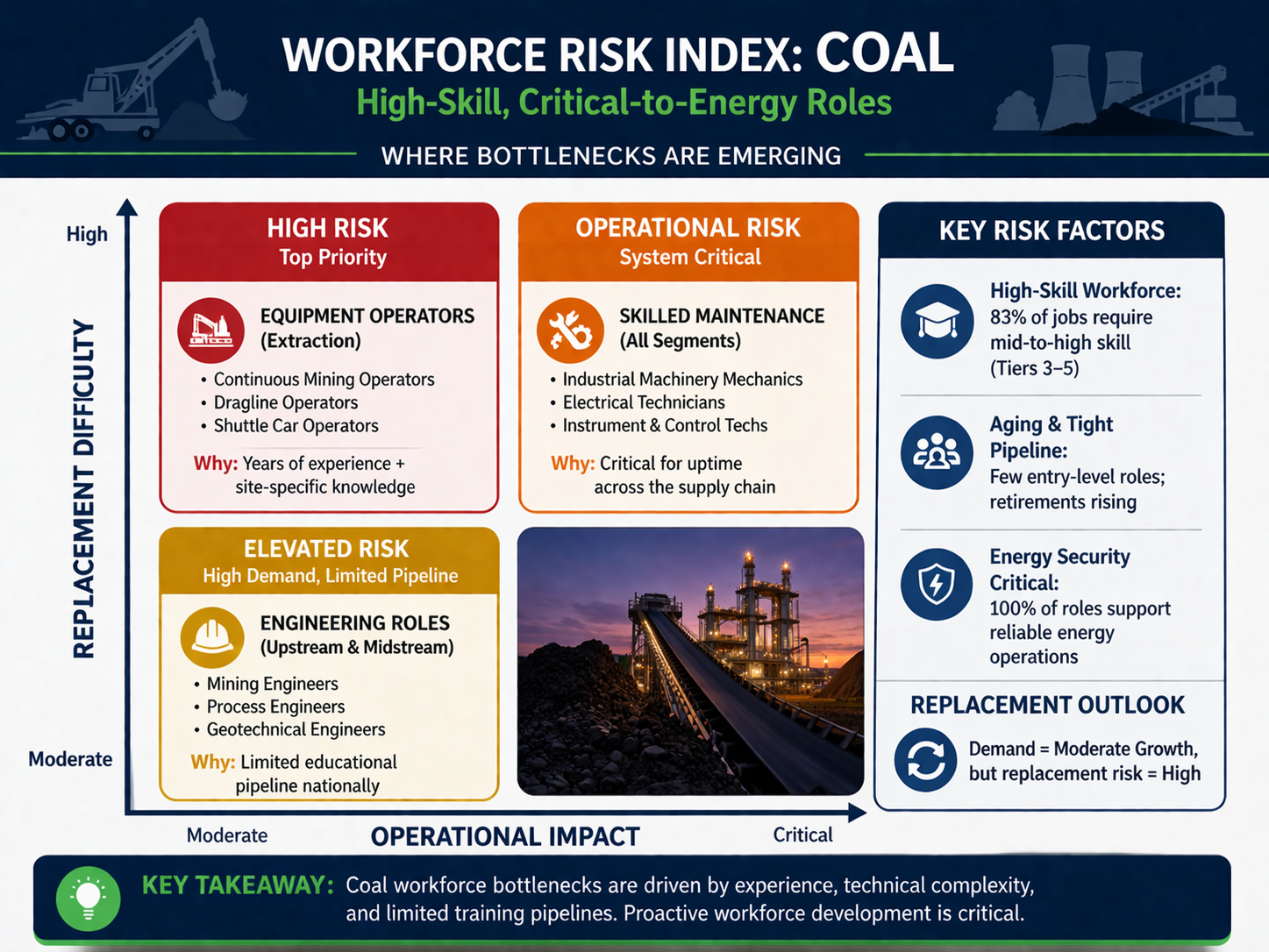
Workforce Risk Index: Coal
High-Skill, Critical-to-Energy Roles
High Risk (Extraction)
Continuous Mining Operators · Dragline Operators · Shuttle Car Ops
Why: Years of experience + site knowledge
Elevated Risk (Engineering)
Mining Engineers · Process Engineers · Geotechnical Engineers
Why: Limited educational pipeline nationally
Operational Risk (Skilled Maint.)
Industrial Mechanics · Electrical Technicians · Instrumentation and Controls Techs
Why: Critical for supply chain uptime
100% Criticality
Reliable Energy Operations
Risk Factors
83% High-Skill roles
Experience Dependency
Retirement Risk
Outlook
Job Demand — Moderate Growth
Replacement Risk — High
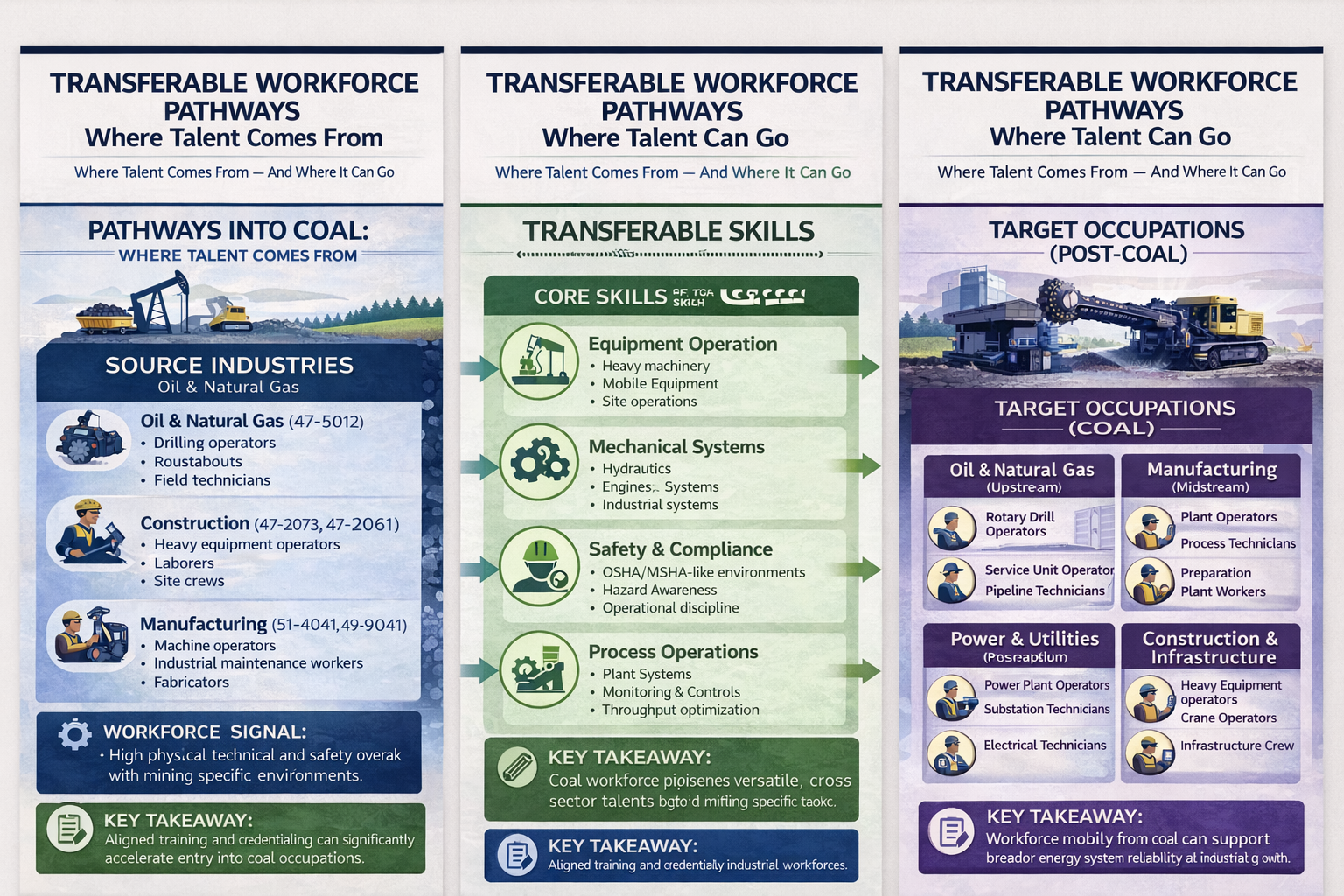
Transferable Workforce Pathways
Entry and Exit Mobility
Source Industries
Oil and Natural Gas
Construction
Manufacturing
Core Transferable Skills
Equipment Operation
Mechanical Systems
Safety and Compliance
Pipelines are versatile; cross-sector talents bridging specific tasks.
Post-Coal Targets
Substation Technicians
Infrastructure Crew
Service Unit Operators
Coal workforce mobility supports broader energy system reliability.
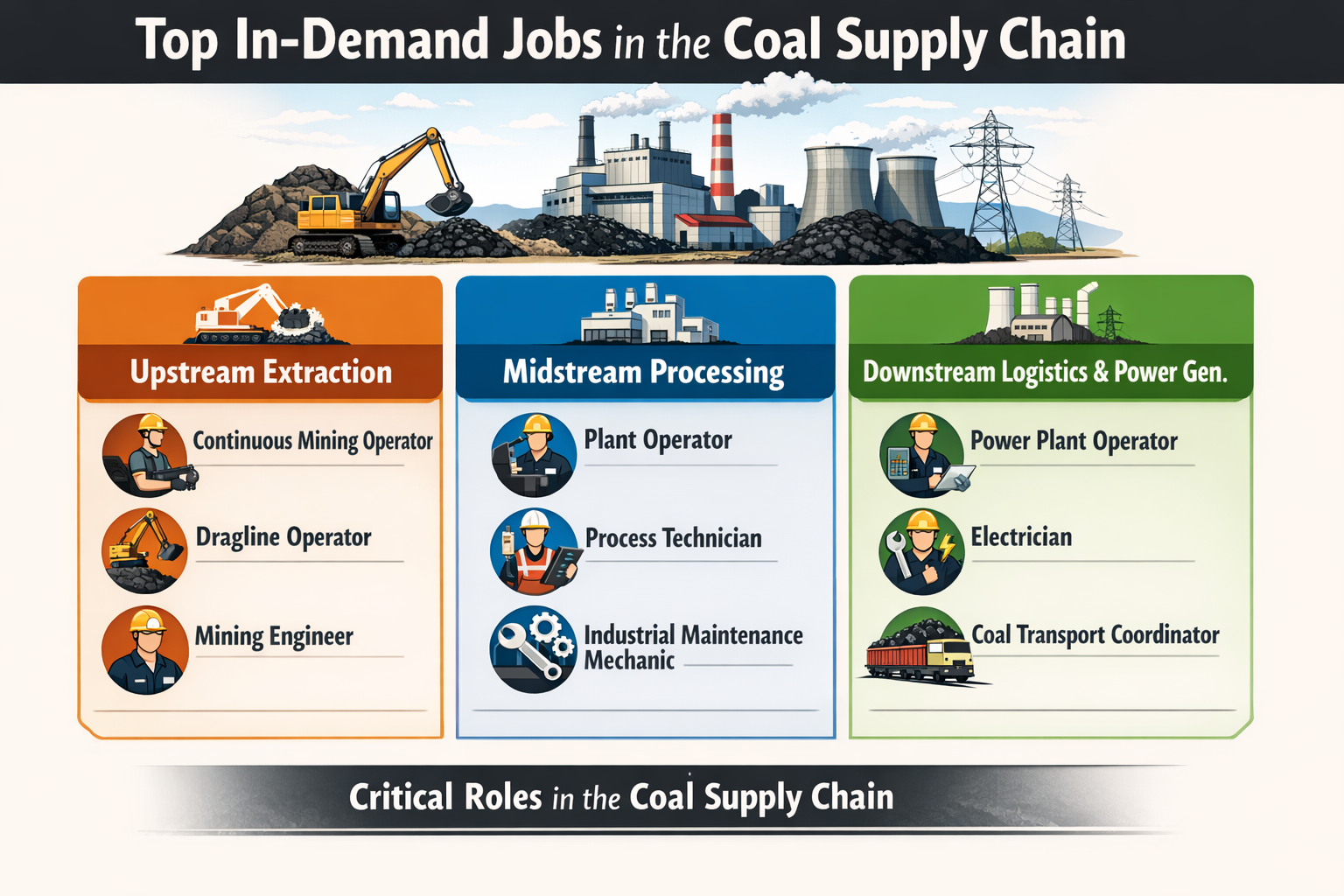
Top In-Demand Jobs by Supply Chain
Critical Roles Mapping
Upstream
Continuous Mining Operator
Dragline Operator
Mining Engineer
Midstream
Plant Operator
Process Technician
Industrial Maintenance Mechanic
Downstream
Power Plant Operator
Electrician
Coal Transport Coordinator
Strategic Technology Awareness
NETL Research and Development (R&D) Thrusts
High-Value Products From Coal
Coal is being transformed into carbon fibers, battery components, and structural additives, — ,unlocking new manufacturing markets beyond traditional fuel use.
Manufacturing
Coal and Carbon Feedstock Conversion
Advanced processes using microwaves and plasma enable more efficient conversion of coal into essential chemicals and industrial materials.
Chemical Tech
Gasification and Reactor Systems
Flexible platforms convert coal into hydrogen and fuels while accelerating technology development and commercialization.
New Fuels
Accelerated Process Design
Advanced simulation tools optimize systems, reduce development risk, and speed up deployment of next-gen energy technologies.
Simulation
Integrated Energy Systems
Modernizing coal usage with storage and hybrid integration will improve grid flexibility, efficiency, and system resilience.
Grid Reliability
Carbon Capture for Coal Technologies
Pulverized coal power remains important for expanding grid capacity to support SI growth, the operation of new data centers, and ensuring affordable, reliable, and secure electricity for the nation. Maintaining these assets requires modernization, including carbon capture for enhanced hydrocarbon recovery.
Sustainability
Strategic Priorities
The RWFI is advancing workforce capacity across coal extraction, processing, transportation, power generation, and emerging coal-to-products technologies to support U.S. energy reliability and industrial resilience.
1. Comprehensive Workforce Analytics
Developing a quantitative Workforce Needs and Gaps Analysis will evaluate workforce transferability from adjacent sectors (oil and gas, construction, manufacturing, power generation) into mining operations, coal preparation, maintenance, and coal-based industrial applications.
2. Workforce Readiness
Developing a quantitative Workforce Needs and Gaps Analysis will evaluate workforce transferability from adjacent sectors (oil and gas, construction, manufacturing, power generation) into mining operations, coal preparation, maintenance, and coal-based industrial applications.
3. Strategic Workforce Integration
Aligning workforce analysis with federal and state energy policy, grid reliability priorities, and coal-dependent regional economic strategies will ensure workforce considerations are embedded in planning and investment decisions.
4. Industry and Education Alignment
Catalyzing coordination among mining operators, power producers, equipment manufacturers, unions, universities, and community colleges will align training pathways with evolving safety requirements, advanced mining technologies, and coal-to-products innovation.
5. Digital Infrastructure
Expanding the Workforce Hub and online Playbook will provide interactive dashboards, regional workforce indicators, occupation pathways, and transition tools tailored to coal economies and the broader coal value chain.