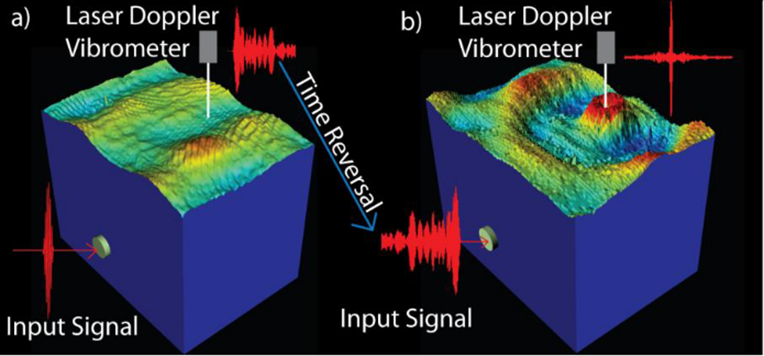
Los Alamos National Laboratory, along with partners Sandia National Laboratory, the University of New Mexico, and Chevron Energy Technology, will work to improve capabilities to identify damaged wellbore materials and potential leakage pathways in existing wells through a proof-of-principle study for the development and field validation of an advanced diagnostic tool based on non-linear acoustic probes and time-reversal methodology. This will lead to improved prediction, identification, and quantification of wellbore leakage risk. The tool is based on focused acoustic energy and the unique time-reversal method to image and detect behind-casing damage in wellbore systems. The sensor technology will image the existence, 3D orientation, and extent of damage zones within wellbore materials and composites.
Principal Investigator
Pierre-Yves Le Bas
pylb@lanl.gov
Project Benefits
The project will result in development of an acoustic probe tool, and data and analysis from laboratory measurements of wellbore materials in various experimental conditions and in-situ field validation tests. This will lead to a new method of monitoring and identifying potential well leakage and new understanding of the relation between stresses, well damage, and leak permeability. It will provide a means of locating remediation targets and assessing the success of remediation efforts. The effort will also support the Carbon Storage Program mission to develop and advance carbon capture and storage technologies for widespread commercial deployment in the 2025-2035 timeframe that will ensure safe, secure, efficient, and cost-effective CO2 containment in diverse geologic formations.
Project ID
FWP-FE-634-15-FY15
Website
Los Alamos National Laboratory
http://www.lanl.gov/