Business

Business
The goal of the project — being jointly performed under projects with Louisiana State University (DE-FE0028966) and the U.S. Geological Survey (DE-FE0026166) — is to provide a quantitative basis for reservoir models to account for the impact of clays and other fine-grained material (fines) on reservoir compressibility and permeability, two key factors in controlling the flow of gas and fluids toward a gas hydrate production well.
Louisiana State University (LSU), Baton Rouge, LA
US Geological Survey (USGS), Woods Hole, MA
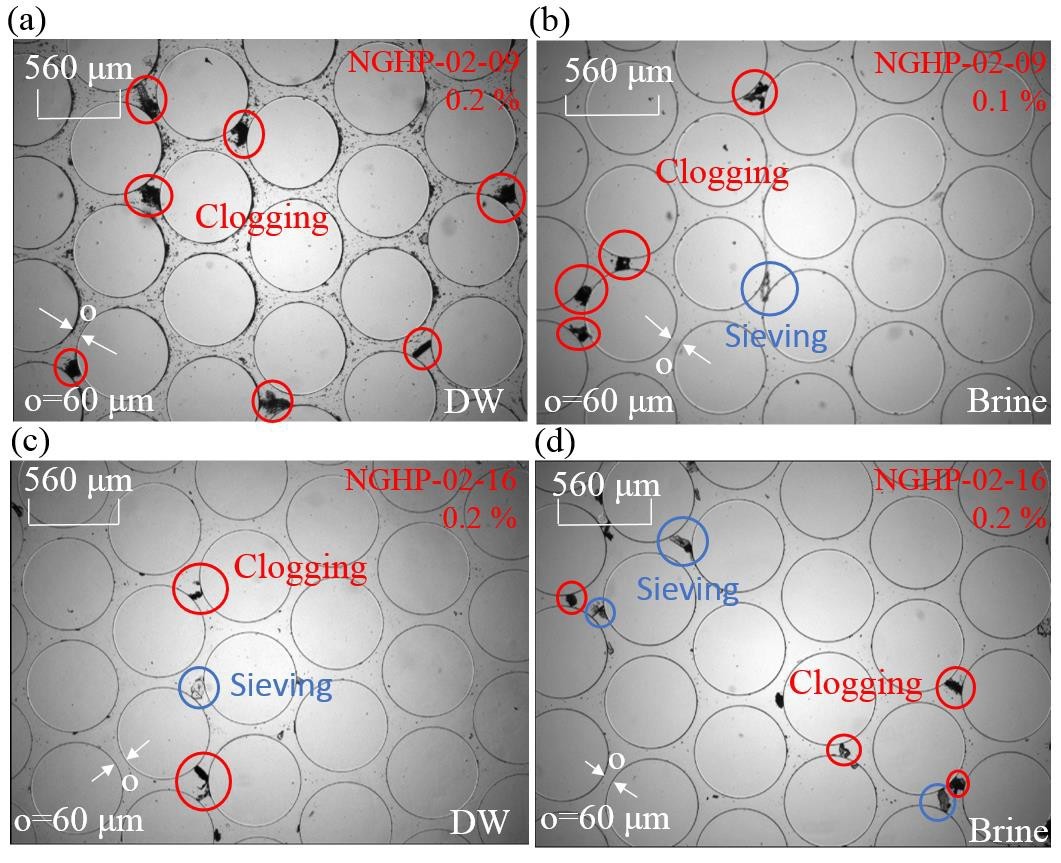
The quantity of methane potentially recoverable from gas hydrate is large enough to motivate federally supported production tests in several countries, which in turn motivates studies of reservoir production efficiency. Evaluating long-term production well viability involves modeling permeability evolution in the reservoir sediments around the production well because processes reducing the flow of gas into the production well also reduce the long-term economic viability of the well. Fine particles, such as clays, exist nearly ubiquitously in the permafrost and marine settings that typically host gas hydrate, and fines reacting to fluid flow by migrating and clogging pore throats can reduce flow toward the production well. Many fines are sensitive to variations in pore-fluid chemistry, swelling in reaction to in situ pore brine being displaced by fresh water liberated from hydrates during dissociation.
Additionally, fine particles tend to collect at gas/water interfaces created by the multiphase flow of gas and water. Thus, as methane and fresh water flow from the hydrate-dissociation front toward the production well, fine particles in the reservoir sands, interbedded fine-grained layers, and seal layers can be swelled and/or migrated, potentially clogging pathways and limiting flow to the production well.
This project is expected to result in both increases in fundamental scientific understanding of hydrate system behavior during production and site-specific impacts related to specific potential production sites offshore India by the National Gas Hydrate Program (NGHP) of India.
Site-specific impact: Results from this research directly inform DOE-funded reservoir modeling work being undertaken for the most promising NGHP field sites. Sediment compressibility and permeability are two of the three highest-priority parameters (the third being sediment strength) for DOE’s reservoir modeling in preparation for an NGHP production test.
Ongoing work at Japan’s Advanced Industrial Science and Technology laboratory (AIST) and USGS on NGHP pressure cores is not designed to quantify how compressibility and permeability in the presence of hydrate change as the in situ pore-water brine continues to be displaced by the gas and fresh water produced during hydrate dissociation. The pressure core studies are also unable to distinguish whether the compressibility and permeability changes are due to the swelling or the migration of fines. This specific research fills that need, providing modelers at DOE and elsewhere with information on how reservoir compressibility and permeability are likely to evolve over time in the NGHP areas of interest.
Fundamental issues of global impact: to benefit production assessments of hydrate-rich systems elsewhere in the world, this research includes a systematic study of common fines and their impact on compressibility and permeability over a controlled range of concentration in sandy sediment. The matrix of experiments covering the range of common fines and fines concentration in sands will be used to build a results database that can be used to estimate property changes in hydrate-bearing sand targeted for production. The database would be most useful once a site has been cored, with X-ray powder diffraction (XRD) analysis to reveal the fines types and concentrations.
A second global scientific impact of the research will be an enhanced understanding of fracturing due to breaking clogs that form due to fines migration. Quantifying the controlling parameters for this phenomenon provides guidance on a reservoir’s permeability evolution; in addition to providing a mechanism for explaining permeability drops and rebounds that may occur during production, clog fracturing has the potential to cause long-term permeability increases as fractures remain at least partly open once formed by this process.
Project activities have been completed and a final scientific and technical report is available from the additional information section below. Key takeaways from the project include:
DOE Contribution: $236,127 (LSU — $180,354; USGS — $55,773)
$61,542
NETL – Richard Baker (richard.baker@netl.doe.gov)
LSU – Dr. Shengli Chen (shenglichen@lsu.edu) and Dr. Jongwon Jung (jjung@lsu.edu)
USGS – Dr. William Waite (wwaite@usgs.gov)
Final Project Scientific /Technical Report [PDF] July 2019
OSTI Identifier