Business

Business
efficiently captures carbon dioxide from air; heavy metals, critical minerals, and rare earth elements from water; and all from industrial emissions
PCT Patent Application No. PCT/US2023/085206
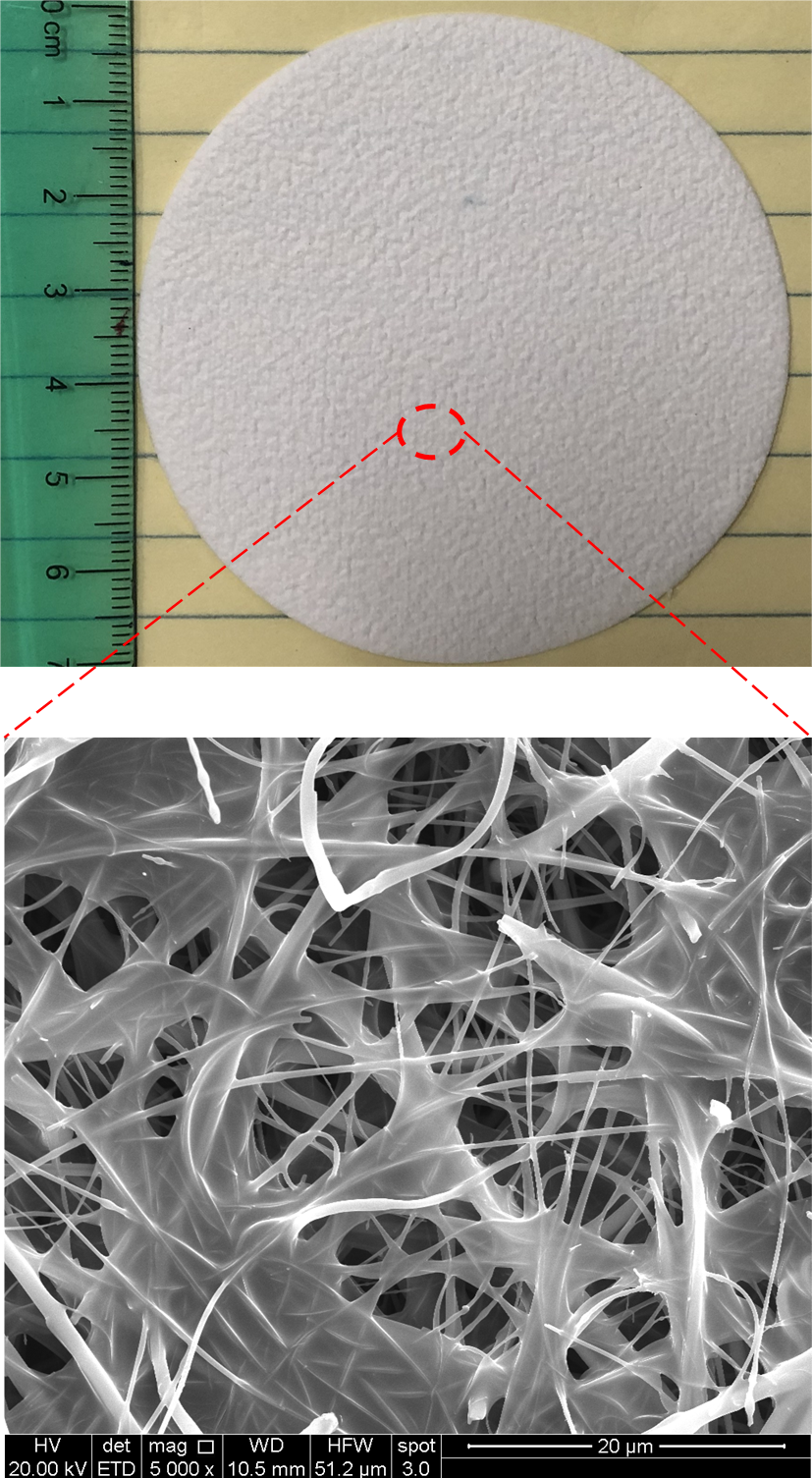
Glass giber fiber sheet (top) and scanning electron microscope (SEM) image of the functionalized fiber network.
NETL researchers improved their basic immobilized amine sorbent (BIAS) technology for carbon dioxide (CO2) capture and wastewater treatment applications by developing a fibrous amine-functionalized matrix (FAM) glass fiber flat sheet sorbent. This innovation involves directly dip-coating the formula solution onto a microfiber flat sheet then curing and drying at elevated temperature. Compared to NETL’s patented particle sorbents, the flat sheet sorbent displays higher capacity and faster uptake kinetics in CO2 adsorption and in aqueous rare earth elements, critical minerals, and heavy metals recovery. For CO2 capture, FAM can be rapidly regenerated via a low-cost, energy-efficient microwave-assisted process. For ion adsorption, FAM demonstrates excellent tolerance to a wide pH range from 3-12. Compared to traditional particle sorbents, the FAM avails more technically and economically feasible applications to amine sorbents. This versatile technology can be applied in various industries, including environmental remediation and industrial gas treatment, providing a scalable solution for reducing pollutants.
Capturing carbon dioxide (CO2) from air and industrial emissions is vital for mitigating climate change. Existing methods like solvent adsorption/absorption, solid particle sorbents, and membrane separation often face challenges, such as high energy requirements, slow kinetics, limited sorption capacity, and complex regeneration processes. Similarly, removing heavy metals from aqueous environments is critical for environmental protection and public health. However, current techniques can be inefficient, generate secondary waste, and involve cumbersome handling and regenerations. These limitations highlight the need for advanced, energy-efficient, and easily deployable technologies that offer high capacity, rapid kinetics, minimal waste, and simplified operational processes for effective contaminant removal.
This invention introduces an innovative FAM technology for efficient removal of CO2 from gases and heavy metals from fluids by creating a functionalized flat sheet sorbent through a one-step thermal treatment process involving coating layers of a polyamines-crosslinker- mixture onto a glass microfiber mat. Unlike existing approaches that utilize particle sorbents or methods like solvent extraction and membrane separation, this flat sheet format simplifies preparation, reduces waste, enhances handling with no moving parts, and performs effectively in convective flow applications with shorter contact times. The technology’s versatility and improved efficiency represent a significant advancement over traditional contaminant removal methods.
Under simulated post-combustion and direct air capture (DAC) conditions, the flat sheet sorbent displays 20% greater CO2 adsorption capacity than an identically functionalized silica particle sorbent. Like its particle sorbent counterpart, it maintains its adsorption capacity following multiple rounds of sorption/desorption under standard conditions. As NETL’s polyamine particle sorbents are known to be regenerable at reduced temperatures (65-85°C) using a microwave-assisted method, the sheet sorbent can also be rapidly regenerated using microwaves, at an even lower temperature (40°C).
In wastewater treatment, the sheet sorbent is capable of selectively removing >95% of heavy metals and rare earth elements (REEs). For the uptake of heavy metals, such as lead, it exhibits faster kinetics than the particle sorbent.
Learn more about NETL's Available Technologies.
 Contact