WASHINGTON, D.C. — The U.S. Department of Energy’s (DOE) Office of Fossil Energy and Carbon Management (FECM) today announced it is re-opening a funding opportunity to make up to $500 million available for projects that will help expand carbon dioxide (CO2) transportation infrastructure across the United States. Accelerating the development and deployment of carbon management technology to capture CO2 emissions from industrial operations and power generation, as well as directly from the atmosphere, requires a safe and reliable system that can transport the captured CO2, either for permanent geologic storage or for conversion to useful, durable products. These efforts will reduce CO2 emissions, provide new job opportunities, and enhance our Nation’s energy security.
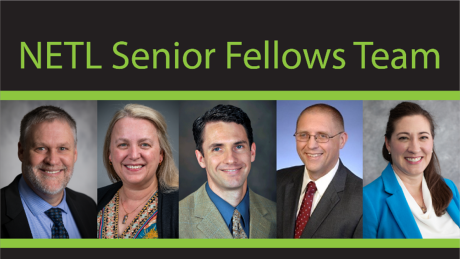
With the recent announcement of Kelly Rose and James Bielenberg as the senior fellows for Computational Science & Engineering and Materials Science & Engineering, respectively, NETL establishes a full cohort of senior fellows, which also includes Nathan Weiland (Energy Conversion Engineering), Alexandra Hakala (Geologic & Environmental Systems), and John Wimer (Systems Analysis & Engineering).
An NETL-supported project, which could offer a path to lower-cost power generation, has successfully demonstrated a supercritical turbine technology in a pilot plant that can produce enough power to supply electricity to approximately 4,000 homes — the largest scale demonstration of the technology ever accomplished.
WASHINGTON, D.C. — The U.S. Department of Energy’s (DOE) Office of Fossil Energy and Carbon Management (FECM) today announced $6 million for one selected project to explore the transport of carbon dioxide (CO2) from onshore industrial and power generation facilities to offshore secure geologic storage in Texas state waters. In addition, DOE announced it will make up to $48M available under the fourth opening of the Bipartisan Infrastructure Law funding opportunity to support regional CO2 transport networks that connect sources of CO2 to locations for geologic storage or conversion to value-added products. Expanding commercial CO2 transport and storage supports the development of a large-scale carbon management industry to reduce emissions, provide new job opportunities, and enhance our energy security.
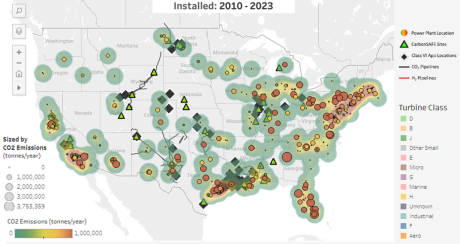
NETL recently published an interactive map showing data on gas turbines installed in the United States from 2010-2023 that tracks trends in installation and annual carbon dioxide (CO2) emissions, demonstrating that the Lab’s research and development of revolutionary, near-zero-emissions advanced turbine technology is helping to change the way the nation generates power.
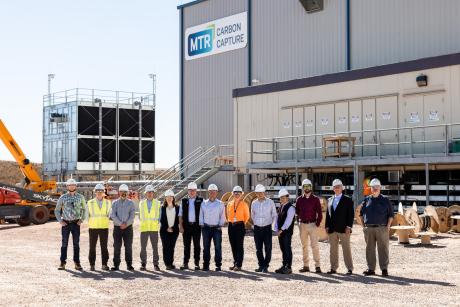
Membrane Technology and Research (MTR) Carbon Capture announced the completion of a carbon capture testing facility at the Wyoming Integrated Test Center (WITC) in Gillette, Wyoming. The facility is the largest membrane-based carbon capture facility in the world. It is designed to capture approximately 55,000 tonnes of carbon dioxide (CO2) per year.
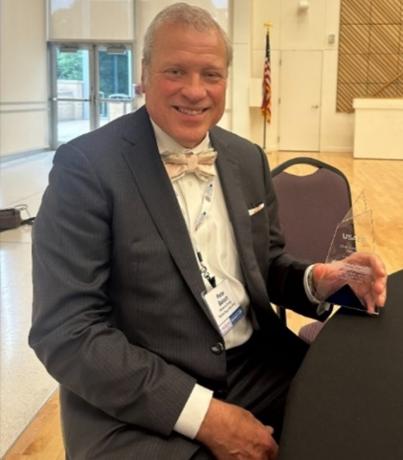
In high school, Peter Balash developed a lifelong interest in rugby, and the valuable lessons learned in those hard-hitting matches have guided him throughout his NETL career, helping him recently earn national recognition as an expert and leader in energy economics.
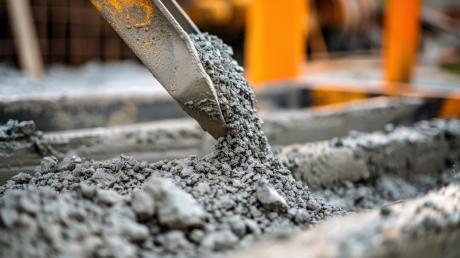
Researchers at the University of California Los Angeles (UCLA), in a project managed by NETL, developed and demonstrated a new approach for making ordinary Portland cement replacement in concrete that can significantly reduce carbon dioxide (CO2) emissions and is already being commercialized for use in U.S. cement plants.
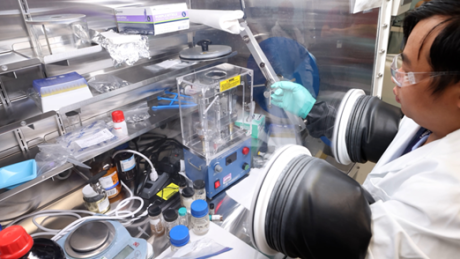
NETL’s research has unlocked a low-temperature synthesis process to make America’s coal waste into critical mineral graphite with a lower processing intensity. This takes what would otherwise be an environmental liability and instead use it to help address rising demand by adding to the domestic supply chain and address commercial market needs for several key industries as well.
Sean Plasynski has been named principal deputy director of NETL.