Business

Business
The Department of Energy (DOE) Cooperative Research and Development Agreement (CRADA) provides a powerful mechanism for collaboration between national laboratories and industry that encourages innovation, advances technology to commercialization, and enables industry to access the facilities and talents of DOE’s national laboratories.
A NETL CRADA participant benefits from:
A CRADA is an agreement for collaboration, and as such, a participant must contribute money and/or in-kind resources in the form of personnel, equipment, facilities etc.
As a way of making the process more simplified, NETL offers a Short Form CRADA for collaborations involving only U.S. participants where the total project value does not exceed $2,000,000. (The total project value includes cash and in-kind contributions by both the U.S. participant and NETL.) To benefit from the simplified process, a participant must accept the terms and conditions of the Short Form CRADA with no modifications. If modifications are desired, the participant may collaborate with NETL using the Standard Model CRADA.
Short Form CRADA Model Short Form CFA Model
The CRADA is authorized by 15 U.S.C. § 3710a and governed by DOE Order 483.1B.
If you have any questions about entering into a CRADA with NETL, please contact Partnerships@netl.doe.gov.
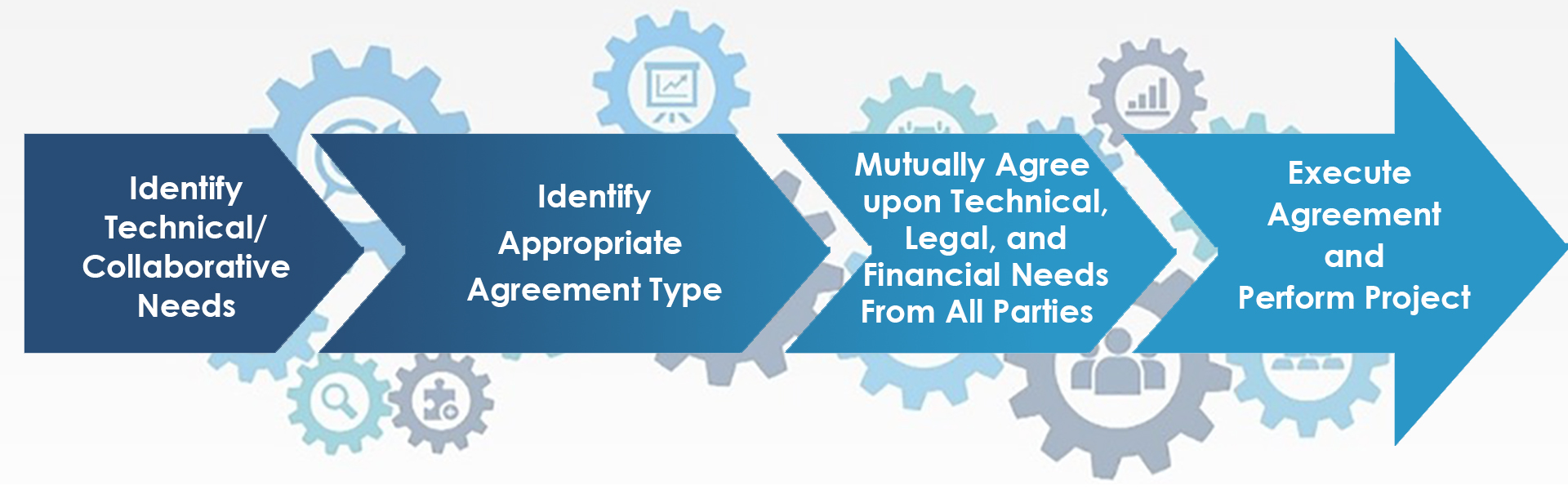
Technology Transfer Agreements are authorized by Federal legislation that enable NETL to jointly work with other Federal and non-federal entities, including private industry, academia, and state or local governments, in ways that can protect new knowledge and scientific/technical information from public disclosure, including the intellectual property interests of collaborating parties. The legislation authorizes NETL to share, exchange, transfer, obtain and/or use information, expertise, facilities, and/or materials with other entities. Such agreements include Cooperative Research and Development Agreements, Contributed Funds Agreement, Memorandum of Understanding or Agreement, Non-Disclosure Agreement, and Technology License Agreement.
Definition:
A CRADA is a collaborative research and development project between NETL and an outside party (includes industry, educational institutions, non-profits, state and local government, and national labs). Can be funds-in to NETL or in-kind contributions from both parties.
A CRADA must be collaborative – meaning NETL and the outside party will be working on the project statement of work tasks together. The collaboration must be substantive – e.g. it is not sufficient for the outside party to simply provide data/samples, etc., and have NETL perform the bulk of the research. All parties to the CRADA will actively participate in the research. Such participation may involve contributions of intellectual input and proprietary information, personnel, equipment, supplies, materials, and facilities. The outside party may also contribute funds.
Benefit:
Allows NETL and outside partners to collaborate on a scope of work while jointly leveraging resources and expertise. Data or information generated under the CRADA may be marked as protected for up to 5 years. Outside CRADA partners will have an option to obtain an exclusive license to a pre-negotiated field of use for NETL’s solely or jointly developed inventions under the CRADA.
Definition:
A CFA permits NETL to perform work for an outside party. NETL must be 100% reimbursed for the project. The outside party does not perform any of the work. Any new inventions NETL makes under the project will be owned by DOE.
Benefit:
Allows access to NETL’s unique facilities, capabilities, and expertise by having NETL perform a scope of work for outside partners.
Definition:
An MOU/MOA is meant to capture the cooperative spirit and summary-level detail behind high-level, long-term, or far-reaching initiatives. MOUs/MOAs are not legally binding agreements and are not appropriate for the more targeted tasks outlined in a statement of work for a specific project – that is better accomplished via a CRADA and CFA.
Benefit:
Broadly states the basic understanding between the parties of tasks to be accomplished and describes the methods for accomplishing these tasks.
Definition:
An NDA is used most often to send potentially patentable information to or receive proprietary or patented information to/from an outside partner for the purpose of evaluating the potential for a future research collaboration or licensing. NDAs are not intended to replace a CRADA, CFA, or License.
Benefit:
Allows the exchange of information which needs to be protected from public disclosure
Definition:
A license allows businesses or research agencies to further develop or market lab-created inventions. Licenses transfer DOE-owned intellectual property exclusively or non-exclusively and should ultimately lead to commercialization. Types of licenses include:
Benefit:
Allows private sector to make, use, and sell DOE-owned intellectual property.
If you have any questions regarding NETL Agreements, please contact us at Partnerships@netl.doe.gov