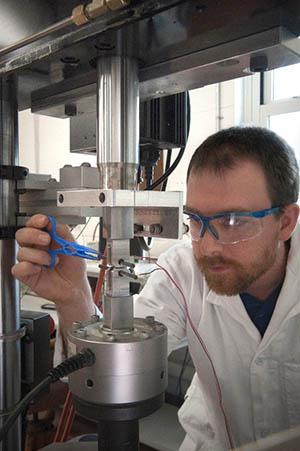
Because supercritical CO2 (sCO2) power cycles can improve thermal efficiency and enable energy production from domestic fossil fuels with responsible stewardship of the environment, NETL researchers are aggressively investigating how to maximize the service life of materials in sCO2environments.
sCO2 power cycles operate similarly to other turbine cycles, but they use CO2 – rather than steam – as the working fluid in the turbomachinery. In its supercritical state, CO2 remains liquid-like rather than gas-like and has unique properties for energy generation equipment. For example, turbomachinery that uses sCO2 can be very compact and highly efficient, requiring less compression and enabling better heat exchange.
sCO2 power cycles operate at very high pressures, which means they operate more efficiently so more energy can be created from less fuel and with a reduced cost. Because sCO2power cycles require higher pressures than traditional power generation systems, the physics, chemistry, and components do not behave as they would in conventional systems.

Business